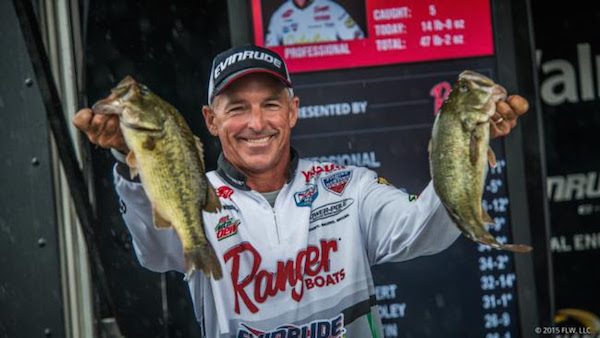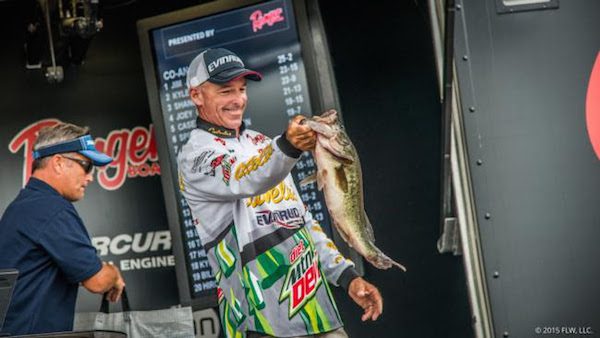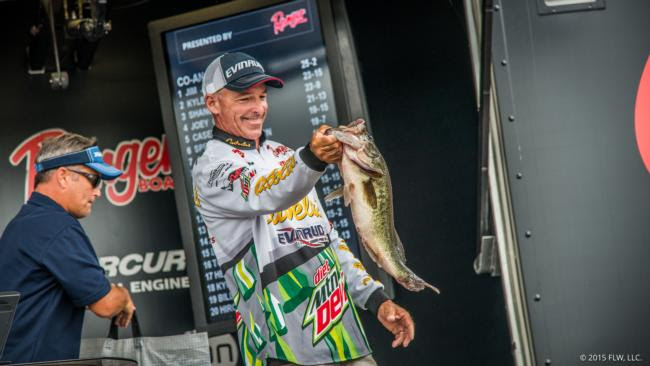
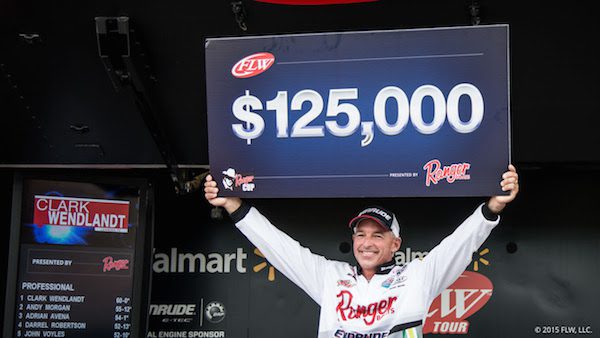
WENDLANDT WINS WALMART FLW TOUR ON POTOMAC RIVER PRESENTED BY RANGER BOATS
Legendary Texas Angler Beats 140 Pros, Wins $125,000 in Nationally Televised Event
[print_link]
SMITH MOUNTAIN LAKE FISHING REPORT
July 2015
DALE WILSON’S
SML GUIDE SERVICE
PHONE NO: 540-297-5650 / 540-874-4950
www.captaindalewilson.com
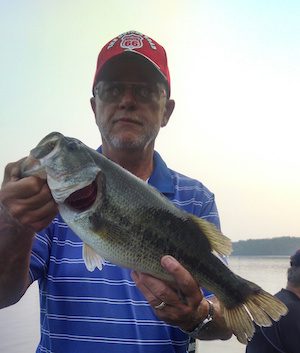
Picture: Jess Henley from Florida with a nice largemouth bass caught and released a few days ago, while fishing with Captain Dale.
OVERVIEW: Fishing will be fair this month! Water temperature will be in the 80’s. Best times will be early morning, late afternoon and after dark. The unusually hot weather has made for tough fishing the past couple of weeks. Night fishing for largemouth bass has been fair. Stripers should start to school and move into their summer habitat soon.
Largemouth Bass- Fishing for largemouth bass will be fair this month. Best lures will be jigs, drop shot rigs, top water lures, Carolina rigs, large Texas rigged plastic worms and shaky heads. Most largemouth bass will be caught near creek channels, rock piles, brush piles, humps, ledges, and deep docks. Best depths will be from the surface to 25 feet deep. Most largemouth bass will have moved to their summer patterns . Rocks, creek channel bends and brush piles are key factors to finding bass this month. Please practice catch and release.
Smallmouth Bass- Fishing should be fair. Best areas will be rocks, humps, ledges, and main channel points. Best lures will be jig & pig, tubes, hair jigs and top water lures. Best areas will be in the mid to the lower sections of the lake. Most smallmouth bass will be suspended this month near schools of baitfish. Cloudy days with light winds are good times to try your luck! Light line and smaller lures will increase your chances to catch smallmouth bass.
Striped Bass- Fishing will be fair. Stripers will be caught in the mid to lower sections of the lake and the
larger creeks. Best lures will be top water poppers, and Zoom flukes fished on 1/2 to 3/4 oz. lead heads. The best depths will be from the 25 to 45 feet deep. Live bait will work this month. Night fishing will be poor this month. Some schools of stripers may surface briefly this month!
Crappie- Fishing for crappie will be poor this month. They will be found 10 to 25 feet deep. Best areas will be in the main creeks around docks, fallen trees, and brush piles in the mid to upper sections of the lake. Small live minnows and 1½ to 2 inch tubes or shad shaped plastic lures fished on 1/16 to 1/8 oz. lead heads will work best to catch crappie this month.
TIP OF THE Month: Make sure you wear plenty of sunscreen and stay hydrated while fishing in the heat of the day! Best times to fish will be early morning and at night. Make sure your running lights are on after dark! The use of a black light at night will help you to see better after dark! Make sure you wear your life jacket. You can never be too careful when boating after dark! Remember to be courteous and obey all the boating laws. Please practice catch and release. Take a kid fishing!


Our guests this week were Bassmaster Elite Series Pro Chris Lane, 2014 Rookie of the Year Bassmaster Elite Series Pro Jacob Powroznik, and from Boater’s Insurance Agency Gabe Berkowitz.
If you missed the show, you can listen to the podcast here.
You can listen to the show on any of the following Set the Hook! with Pat Rose radio network affiliates: Saturday 7-8 am EST on ESPN 105 1 The Zone espnchattanooga.com, 1-2 pm EST on Fox Sports Radio 1670 foxsports1670.com (IHeart Radio app), 7-8 am CST on KEWI 690 am 103.4 FM saline247.com (Tunein Radio app), Sunday 9-10 am EST on Copperhead 1240 Soddy Daisy, TN 1240wsdt.com (Tunein Radio app), 4-5 pm CST on 1480 The Fan! 5-6 pm EST on WKWN 1420 AM 106.1 FM Trenton, GA discoverdade.com/1061FM.htm (Freestream Radio app).
Please visit our sponsors page and tell them Pat sent you! If you would like to advertise on Set the Hook! with Pat Rose, give us a call at (423) 314-4541. Put Set the Hook! with Pat Rose to work for you.
Follow Pat Rose on Facebook at https:/
/www.facebook.com/SetTheHookWithPatRose, he would love to add you as a friend.
Please send any comments or suggestions about this website to [email protected].
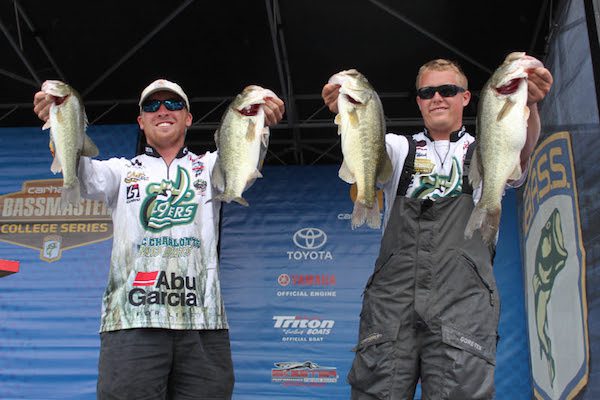
The Carhartt Bassmaster College Series National Championship presented by Bass Pro Shops heads to Lake DuBay out of Stevens Point, Wis., July 9-11. Here, the 2014 champions Andrew Helms (left) and Jake Whitaker of the University of North Carolina-Charlotte will get the chance to defend their title.
June 25, 2015
Top College Anglers To Compete In National Championship
STEVENS POINT, Wis. — Eighty-five collegiate bass fishing teams will converge on Lake DuBay July 9-11 for the Carhartt Bassmaster College Series National Championship presented by Bass Pro Shops, marking the first time for Wisconsin to host the finals.
The field of qualifiers is the largest in the history of the program, according to Hank Weldon, B.A.S.S. College tournament manager. The anglers represent 60 colleges and universities. The teams qualified for the championship through five regional tournaments and a wild card event.
Weldon said Stevens Point boasts a passionate fishing community and will prove to be great hosts for the college students, many of whom will be fishing in Wisconsin for the first time.
“The fishing in DuBay is reported to be tough, yet we’ve seen some of the anglers practicing showing off some really big bass on their social media feeds,” Weldon said. “It’s definitely going to be a challenging event, but the world’s best collegiate anglers need to be challenged for a championship.”
Leading the championship qualifiers is the team of Jake Whitaker and Andrew Helms of the University of North Carolina-Charlotte, who were the 2014 champions and also qualified through the Carhartt Eastern Regional. They’re the first full team to try to defend their title; other championship teams in the past have been broken up through graduation or other changes.
“This is the point that every college angler wants to get to,” Whitaker said. “For us to be automatically qualified was good, but we wanted to prove that we deserved to be there again. To qualify again and have the chance to defend our title is exciting, but at the same time it’s a hard task to accomplish.”
The full field of teams will compete on the 6,830-acre Lake DuBay on Days 1 and 2 (July 9-10). The Top 5 teams will compete for the national championship crown on July 11. Following the team finals, the Top 4 teams will move on to the bracket format in which they will compete individually for a spot in the 2016 GEICO Bassmaster Classic presented by GoPro on Grand Lake in Oklahoma.
Takeoffs will be at 6 a.m. from the Tiki Beach Bar and Grill (1126 County Road DB, Mosinee, WI 54455), and weigh-ins will take place at the University of Wisconsin-Stevens Point Sun Dial (2040 Portage St., Stevens Point, WI 54481).
Bassmaster.com will cover the event with live reports from the lake, live-streamed weigh-ins, photos and stories. Follow all of the national championship coverage on social media as well at www.facebook.com/collegebass and by using the hashtag #collegebass.
Local hosts for the events are the Stevens Point Area Convention and Visitors Bureau, Stevens Point Area Central Wisconsin Sports Commission, Tike Beach Bar and Grill, Travel Wisconsin and the University of Wisconsin-Stevens Point.
To see all of the national championship contenders, click here.
Below is a complete list of Carhartt Bassmaster College Series National Championship presented by Bass Pro Shops qualifiers.
Southern Regional Qualifiers
Thomas Oltorik and James Oltorik of Daytona State College
Baylor Ronemus and Cole Tinsley of Clemson University
CJ Knight and Tim Ward of Auburn University
Cody Spears and Justin Mahon of Florida State University
Austin Littrell and Ben Wall of Auburn University
Patrick Walters and Josh Rennebaum of the University of South Carolina
Murphy Klumpp and Lucas Brown of Auburn University
John Duarte and Jonathan Kelley of Coastal Carolina University
Hunter Gibson and Caiden Sinclair of the University of Alabama
Anderson Aldag and Lee Mattox of the University of Alabama
Josh Oliver and Nathan George of Gadsden State Community College
Ross Burns and Richard Nesbitt of Clemson University
Ross Dove and Richie Young of Emmanuel College
Kevin Lucas and Kyle Stafford of University of Central Florida
Grant Galloway and Joe Marty of Mississippi State University
Jacob Reome and Matthew Garvin of Clemson University
Taylor Minick and Micheal Harbach of Valdosta State University
Frankie Appaluccio and Logan Shaddix of the University of Alabama
Midwestern Regional Qualifiers
Justin Brown and Brandon Bissell of Northern Michigan University
Cade Laufenberg and Wyatt Stout of Winona State University
Austin Brimeyer and Anthony Riesberg of the University of Dubuque
Sheldon Rogge and Lance Maldonado of Kansas State University
Grant Ehlenfeldt and Brett Stanek of the University of Wisconsin-Platteville
Cole Atkinson of St. Ambrose University
Tyler Rocke and Justin Schick of Illinois Central College
Jared Mataczynski and Steve Nebel of the University of Wisconsin-Whitewater
Samuel Moore and Ross Kellermeier of Bemidji State University
Taylor Bivins and Kyle Alsop of Kansas State University
Justin Bruno and Brody Anderson of Grand Valley State University
Trevor Lo and Chris Burgan of the University of Minnesota
Kit Benson and Wes Lashmett of Western Illinois University
Central Regional Qualifiers
John Ledet and Justin Cooper of Northwestern State University
Evan Smith and Aaron Sarna of Arkansas Tech University
Dwight Camp and Jonathan Furlong of Southeastern Oklahoma University
Brock Enmeier and Colten Hutson of the University of Central Oklahoma
Aaron Belgard and Logan Laprarie of Northwestern State University
Tyler Craig and Blake Alford of the University of Louisiana-Monroe
Tyler Stewart and Nick Joiner of the University of Louisiana-Monroe
Josh Bensema and Matthew Mcardle of Texas A&M University
Colby Ogden and Brandon Simoneaux of Lamar University
Garret Lindsey and Clayton Godfrey of Stephen F. Austin State University
Easton Ramsey and Chris Zins of the University Central Oklahoma
Justin Gaskin and James Avant of the University of Louisiana-Shreveport
Brandon Koon and Kyle Winstead of the University of Tennessee-Martin
Western Regional Qualifiers
Laj Tripp and Kyle Sittman of Eastern Washington University
John Zeolla and Clayton Lauchland of California Polytechnic State University
Jarid Gabbert and Taylor Throop of Eastern Washington University
Jacob Wall and Ryan Habenitch of the University of Oregon
Alex Klein of Chico State
Zach MacDonald and Zachary Martinez of Oregon State University
Tanner Austin and Ethan Clark of Sacramento State University
Cy Floyd and Travis Opel of Eastern Washington University
Eastern Regional Qualifiers
Austin Neary and Alex Frazier of Western Carolina University
Chelsey Queen and Kristopher Queen of Bethel University
Kelly Johnson and Jeremy Gilley of Appalachian State University
Edward Rude and Matthew Combs of West Virginia University
Zachary Blalock and Mike Corbishley of East Carolina University
Carson Orellana of Strayer University
Jay Emmert and Christian Peake of the University of Tennessee
Grayson Barber and Hiroto Kinoshita of North Carolina State University
Zander Monk and Taylor Thomas of the University of North Carolina-Charlotte
Hunter Hill and Ethan Howell of Appalachian State University
Cole Blythe and John Auten of the University of North Carolina-Charlotte
Jonathan Peck and Devin Wallis of Bryan College
Jake Whitaker and Andrew Helms of the University of North Carolina-Charlotte
John Garrett and Brian Pahl of Bethel University
Zack Bodford and Matthew Hinkle of North Carolina State University
Matt Allen and Zach Youngblood of Tennessee Tech University
Benjamin Freeman and Dillon McGee of Bethel University
Wild Card Qualifiers
Joshua Butts and Justin Rivers of Wallace State Community College-Hanceville
Phillip Germagliotti and Shane Campbell of McKendree University
Jordan Ledbetter and Trent Robinson of McKendree University
Lance Freeman and Seth Brock of Murray State University
Justin Singleton and Zac Bennett of Georgia College & State University
Alec Castonguay and Garret Whitley of Stephen F. Austin State University
JP Kimbrough and Jared Rascoe of the University of Louisiana-Shreveport
Shelby Hutchens and Brian Blades of Stephen F. Austin State University
Darrell Henson and Brent Rome of the University of Louisiana
Dawson Lenz and Evan Horne of the University of North Alabama
Ethan Snyder and Shaw Owens of Eastern Kentucky University
Brian Eaton and Slade Daniel of the University of Louisiana-Monroe
Tyler Rivet and Allyson Marcel of Nicholls State University
NC Big Bass Showdown Results
A HUGE thank you to everyone that came out today to fish the first NC Big Bass Showdown on Shearon Harris Reservoir as well as our sponsors Torque Power Rods, North Anna Bait Company and C-Squared Lures, llc.
We had 21 boats entered for the tournament and gave cash and prizes out to the top 12 teams as well as hourly cash and prizes to 1st and 2nd for each
Overall Big Bass
1st – $930 + 2 Torque Power Rods- Jason Dew/Tom Elliot – 7.92 lbs
2nd – $500 – TJ Smith/Steven Matthews – 7.38 lbs
3rd – $250 – Jim Freeland/Rodney Bowen – 7.30 lbs
4th – $150 – Seth Ellis/Alan Parker – 5.71 lbs
5th – $100 – Scott Woodson – 5.59 lbs
6th – 1 Torque Power Rod – Travis Parker/Erby Parker – 5.17 lbs
7th – 1 Torque Power Rod – Ernest Wentworth/Anthony Randall – 4.92 lbs
8th – 4 pack ShredFyn Lures C-Squared Lures – Mark McCowan/Craig Scalf – 4.83 lbs
9th – $25 gift card North Anna Bait Company – Durant Blanton/Chad Farino – 4.22 lbs
10th – 4 pack ShredFyn Lures C-Squared Lures – Mike Lamb/Ron Mattingly – 4.12 lbs
11th – North Anna Bait Company Prize Pack – Shawn Hicken/Jody Sykes – 4.11lbs
12th – North Anna Bait Company Prize Pack – Mike Eggars/Mark Willis – 3.94 lbs
Hourly Big Bass Cash Prize was $100 per hour.
1 – Rory Saliger/Rob Ross – 1.71 lbs
2 – Durant Blanton/Chad Farino – 4.22 lbs
3 – Jim Freeland/Rodney Bowen – 7.30 lbs
4 – Jason Dew/Tom Elliot – 7.92 lbs
5 – Durant Blanton/Chad Farino – 1.93 lbs
6 – Ernest Wentworth/Anthony Randall – 4.92 lbs
7 – 5th – $100 – Scott Woodson – 5.59 lbs
8 – 4th – $150 – Seth Ellis/Alan Parker – 5.71 lbs
Thanks again for everyone that came out.
The next NC Big Bass ShowDown has been scheduled for August 29th on Falls. Launching out of Ledge Rock. Hope to see you all there!
Long before web-based fishing forums and social media – finding the best fishing intel was still about networking. Used to be that one of the best ways to learn a new lake was to do a little digging around bait shops, greasy spoons and bars. Armed with nothing more than a little humility and a firm handshake, the end result was often a lake map scribbled on a bar napkin and a new fishing buddy. Shut off the power to Facebook and this is still a great way to learn to waters.
But, there are also a host of other tools available to today’s angler that can minimize the amount of time needed to find and pattern fish.
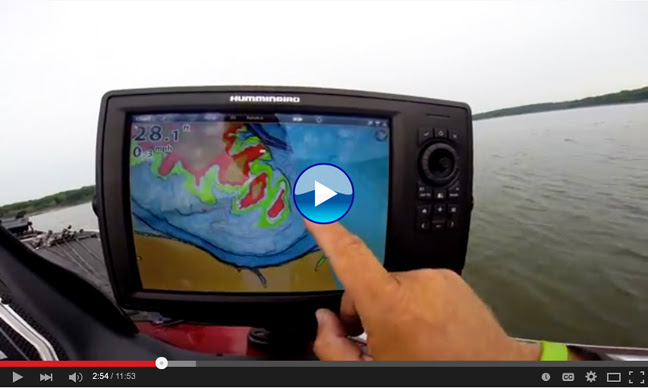
Bass pro Doug Vahrenberg demonstrates the big payoff of running Humminbird SmartStrike on his ONIX unit
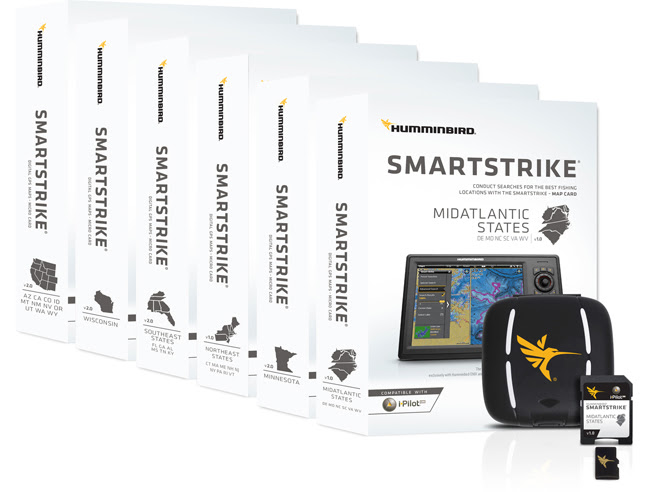
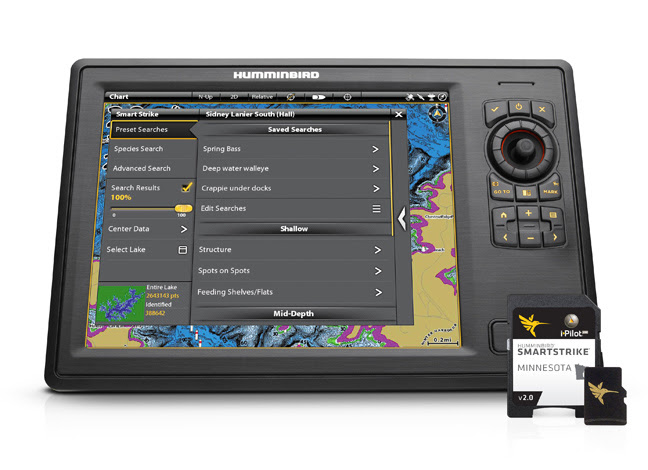
One of the newest and most powerful is Humminbird’s SmartStrike, an SD card-based software program designed for use on Humminbird ONIX and ION fish finders.
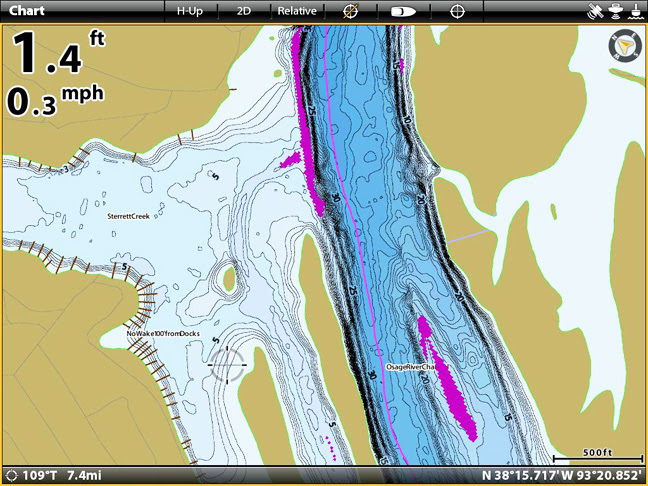
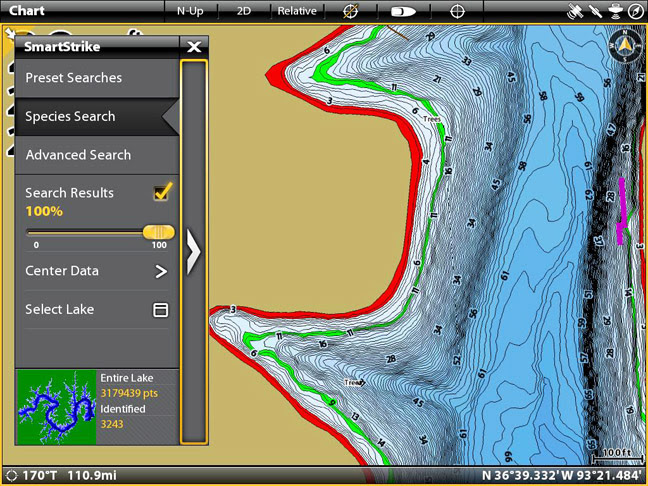
In a nutshell, SmartStrike allows you to harness LakeMaster map data and an extensive onboard database to pattern fish. Based on search parameters like fish species, season, time of day, and weather conditions, SmartStrike highlights areas of the lake map where your target species may be located, minimizing wasted casts. It’s like having your own personal local fishing guide with decades of experience.
Build detailed searches by selecting your desired search criteria. Or searches can be fast and easy: Simply click on any location on the water, select Find Similar Areas, and millions of data points are searched to return other areas like the one you selected. The SmartStrike engine searches depth ranges, aspect, type of structure, proximity to major types of lake structure, and more to quickly reveal your results.
Since we all wish we had more time on the water, a product like SmartStrike that promises to put anglers on fish faster should be looked at very seriously. For pros, the ability to fish a like local can mean big payouts. The rest of us? More fun on the water with family and friends – priceless.
Missouri-based bass pro Doug Vahrenberg is one angler who’s currently put SmartStrike into his fish-finding routine.
“Multi-day tournaments come down to finding the right pattern,” says Vahrenberg.
Vahrenberg illustrates his point with a conversation he had with bass legend Rick Clunn about the difference between one-day vs multi-day bass tournaments. Clunn broke down the role of luck from 80% in a one-day tournament, 60% in a two-day tournament and down to 30% by day three. Basically, that multi-day tournaments take more skill than luck – or one big fish. The winner is typically the angler who can uncover the most consistent pattern. Of course, that starts with location. And one hopes that what emerges is a big fish pattern.
“For me, SmartStrike becomes that tool to hedge the bets in my favor. It’s a great search tool to use before I even get to the tournament. I turn on the unit at home, go in and select the conditions I think we’ll be facing and it quickly highlights areas where those seasonal bass patterns may come into play,” says Vahrenberg.
He says there’s “not much of a learning curve” with SmartStrike. “I was really surprised by how simple it is to use, whether you use the touch screen or buttons on your ONIX. It’s intuitive and fast.”
Case Study #1: Lake of the Ozarks
One of Vahrenberg’s first experiences with the power of SmartStrike happened last summer on Lake of the Ozarks.
“One of the things I look for during summer are ledges along river banks or near creek mouths – typical channel swings close to the bank. But sometimes bass want the steeper banks, because they offer more comfort than a sloping bank. A bass can move up to feed and then slide back deeper to rest and metabolize that food without losing a ton of energy. With SmartStrike you can actually dial in gradual vs steep breaks. Again, saves me a ton of time.”
Although Vahrenberg had a good idea there would be fish located on this specific type of structure and depth contour, SmartStrike quickly reinforced his plan.
“But SmartStrike is a lot faster than I am at finding specific locations. I would have spent hours studying the map and dropping waypoints. Its search algorithms label spots in no time flat. Then, if I catch a fish on a specific spot, I can enter in the criteria for that spot, and it will find me every other spot on the lake just like it. You can build and test a pattern pretty fast!”
Case Study #2: Table Rock Lake
“I was getting ready for a tournament this spring on Table Rock. I knew going in that we were looking at pre-spawn/spawn conditions. I ran SmartStrike and it highlighted ledges, points, and coves in the back of bays. And it was right on. That time of year bass will transition from the points and spawn in the back of those pockets. It showed that clearly.”
But Vahrenberg doesn’t just run to the recommended spots and start casting. He’ll first investigate the SmartStrike-recommended locations with Side Imaging.
“Not every one of the spots held fish, but some of them did. What it does is give you a fast and efficient way to start building a pattern. No wasted casting. It’ll tell me some places to go look at, then I’ll use my Side Imaging to validate if those are places where the fish are.”
Case Study #3: Truman Lake
“It was the June 1 on Truman Lake, fish had spawned and I hadn’t fished there for a long time. I saw the bream moving in and started throwing a square bill. Using SmartStrike, I could find where the flat met the channel swing. I found similar areas and every spot where there was a flat and a channel swing off the bank I caught fish. And good fish in the 4 – 7 pound range.”
The proof’s in the pudding. Vahrenberg’s experience with SmartStrike that day on Truman put him on more and better fish than a local expert.
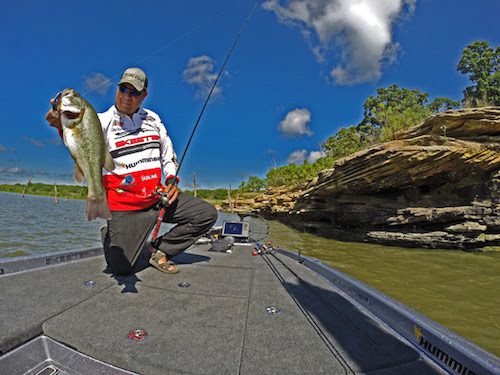
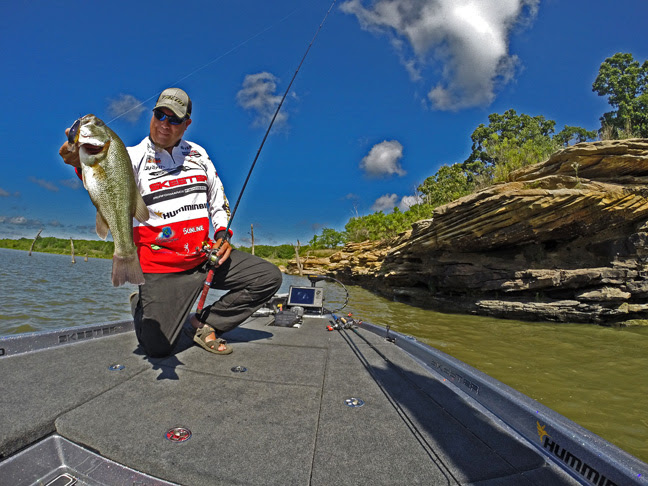
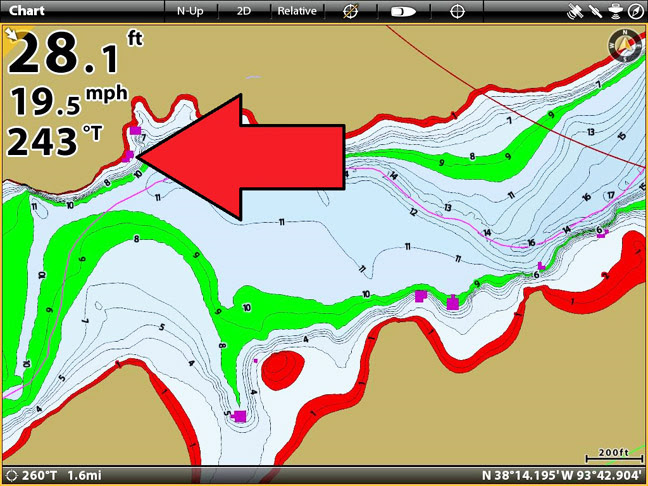
See the arrow? One of many fish-holding spots SmartStrike predicted on Truman Lake — also exactly the spot where Vahrenberg caught the bass in the photo at the top of this story.
“That same day a buddy who lives on the lake only caught a couple. I caught 15 to 20, even though I was basically fishing the lake fresh. The deal was the females were post-spawn, but were up on the flats eating bream before moving out on the main lake. And SmartStrike showed all those spots. This bite only lasts a couple days, but I got on it. It’s a cool deal on Truman but will happen across the country.”
One Step Ahead of the Weather
Another key benefit of SmartStrike is the ability to model various weather scenarios, giving you a flexible game plan when it comes time for your fishing trip or tournament.
“You might be thinking pre-spawn going into a tournament and find that they’re post-spawn. With a few button clicks you can have a new game plan in no time flat. Or I can model for changing weather conditions at home or in real time. That’s powerful.”
Similarly, SmartStrike allows you to search specific depth ranges, too, like shallow, mid-depth or deep areas.
“If I’m struggling I’ll punch in different criteria and see what SmartStrike recommends. That, plus my knowledge, plus Side Imaging, 360 Imaging … It’s just another tool in the toolbox to help you find the best locations.”
Vahrenberg says another powerful feature is SmartStrike’s ability to Find Similar Areas.
“Structure is a major deal in the Bass Opens. We think more about structure on deeper impoundments or river systems but even on shallow-water reservoirs, there’s still structure bass relate to. Might be only a foot drop or a specific aspect of a creek channel. Like channel swings early in the year. From pre- through post spawn they’re super critical. With SmartStrike you can run these scenarios and pre-fish the spots fast.”
Lastly, Vahrenberg says it’s amazing what SmartStrike reveals even when you’re the local and fishing waters you’ve fished for decades.
“It’s mind-opening what happens when you run SmartStrike on lakes you know. I guarantee you’ll discover new spots that you’ve overlooked.”